Gamania · hidol
hidol achievements & quests
How a feature that was shelved and revived a year later took weekly post engagement among active users from 17% to 80%.
01What I was actually doing
hidol is a community platform for fans and creators. I led it end to end, from positioning and roadmap to MVP. As Product Owner I owned release scope, prioritization and product trade-offs, led a cross-functional Scrum team of iOS, Android, front end, back end, QA and product design, and worked with a six-person external team at SotaTek in Vietnam on specs, progress, acceptance quality and delivery risk.
It isn't big, but it was built from nothing — the positioning, the core use cases and the metrics framework were all ours to define.
This piece is about one feature: the achievements and quests system. I chose it not because it has the best numbers, but because it shows the whole way I make decisions — including the decision not to build.
02The first decision was not to build it
I first proposed an achievements system in January 2024. A month later, after discussion, the team decided to shelve it.
The reasons were practical. An achievements system has to answer “who are we encouraging, to do what, and what do they get back” — and at that point we didn't yet have a clear picture of the users we wanted to grow. Without that, quests could only be designed by guessing. Guess wrong and you reward behavior you don't actually want, and once a mechanic like that ships, habits set in and are hard to undo.
The second reason was capacity. The app, the operations back office and the creator platform were all moving at once, and the team's attention was already split. Forcing a feature that shapes long-term behavior in that state would most likely have produced a points board nobody cared about.
Building a reward system before you know who to encourage to do what is putting the cart before the horse.
03A year later, both preconditions were in place
More than a year later, things had changed. The product strategy had clearly shifted toward user-centered community building, and a clear user profile had emerged from actual usage — we finally knew whom to encourage and what to encourage.
The problem was no longer an abstract “not enough engagement” but a concrete number: only 17% of weekly active users were posting or engaging, and retention growth had stalled. People were reading, but nobody was responding — for a community product, that is more dangerous than having no traffic.
When the achievements system came back at this point, it meant something completely different. It was no longer “a feature that sounds nice” but an answer to a specific problem. And this time I cut the scope to the minimum: achievements at the fan-club level only — no platform-wide layer, nothing on the creator platform, no points economy.
The same idea is a drain when the preconditions are missing, and a remedy once they are in place.
04The hard part was three tensions
1. Should we encourage daily engagement, or would that create a pile of empty tasks?
Daily check-in tasks are the easiest way to push numbers up, and the easiest way to turn content into noise. Our trade-off: keep a minimal daily task as a reason to come back, but make the quests climb a ladder — from likes and comments up to things you can only complete when someone responds to you, or when you create something.
2. How do you keep achievement from feeling hollow?
A fan community runs on sincerity. Forcing gamification onto it can cheapen the whole platform — people notice right away when they're being “designed”.
Our answer: don't just hand out virtual badges; make real relationships the achievement. So one quest is “They noticed you” — completed when the idol personally likes, comments on or replies to you. The system doesn't give you that. Someone actually saw you.
3. Build it in the app or on the web?
Quests need to change quickly with the operations calendar, but every app update has to go through store review, and the rhythms don't match. We built the achievements page on the web and embedded it in the app, so quest content can be updated instantly without waiting on review cycles.
That looks like a technical decision, but it's a product one: how often you want a feature to iterate decides which layer it belongs in.
05How the quests were designed
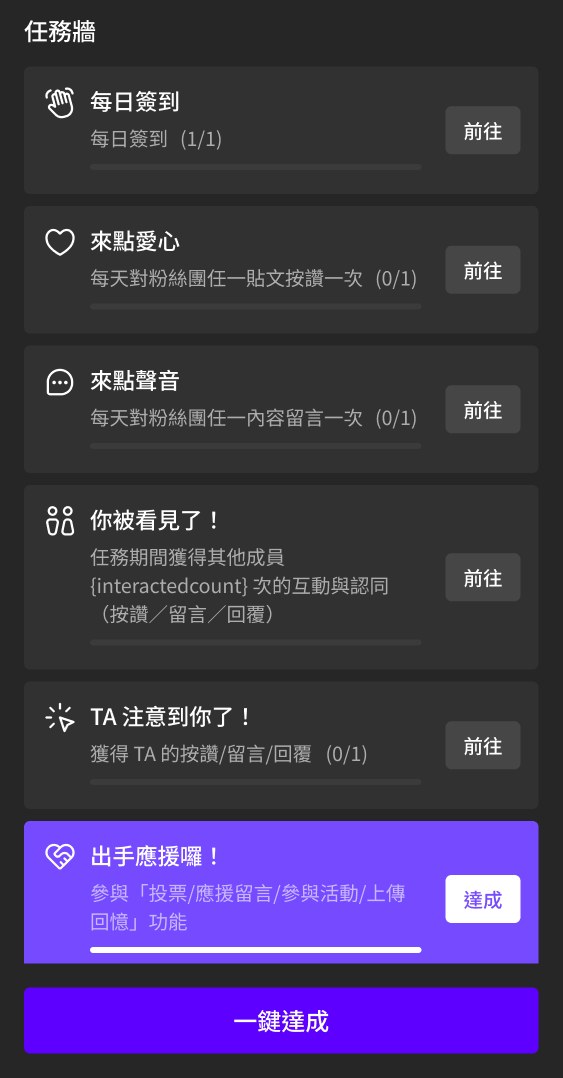
The launch version had six quests, each asking for a bit more effort and initiative than the last:
The lowest bar. Its only job is to bring people back.
Like any post in the fan club once a day. The first step from watching to acting.
Comment on any post once a day. A little more effort than a like, a lot more value.
Get engagement and recognition from other members during the quest period. You can't complete it on your own.
Get a like, comment or reply from the idol personally. The emotional core of the whole design.
Vote, post a cheer, join an event or share a memory. From engaging to contributing.
We deliberately split the leaderboard in two: “Quest champion” ranks completion, “Engagement champion” ranks interaction volume. One leaderboard produces one kind of winner; two give people with different motivations each a stage of their own.

Two pieces of homework before building
1. I took apart the achievement systems of seven platforms. YouTube, Instagram, Xiaohongshu, Discord, Twitch, Dcard and Bilibili — for each, the design goal, target users, how it's applied, and its strengths and weaknesses, then grouped them into four mechanism types and three reward types. The takeaway: creator-facing mechanics motivate strongly but have a high bar; purely emotional rewards are light but lack long-term pull. hidol needed the ladder of the first with the low bar of the second.
2. I defined the metrics before any work started. The North Star metric was broken down across six modules, and every feature had driver metrics and guardrail metrics, each with a formula and a target. Driver metrics prove it works; guardrail metrics make sure nothing breaks while it does.
06The results, and the side effects
A badge looks like decoration, but it answers a more fundamental question than any quest: after people invest, what's left of it? If quests reset to zero once finished, effort never accumulates. A lightweight avatar badge is the system saying “I remember what you did.” It was also a deliberate foundation — a fuller reward and identity system later on would need to grow from that sense of being remembered.
But if this piece stopped there, it wouldn't be honest. After launch, we saw three things in the data and in the community:
I don't think that makes the feature a failure — 17% to 80% is real, and so are the fans who were seen. But a product person who only watches the line they pushed up will miss what's happening underneath it.
The next step for achievements comes down to one idea: move from task-driven to value-driven.
07Where the product goes next
Achievements solved “will people already on the platform start taking part.” But the real long-term question for a content community is how to get the right content to the right people.
The direction I set: first use rules to build up content categories and preference signals, then talk about algorithms. Models need clean training data, and data quality depends on whether content was labeled correctly from the start. Rushing to an algorithm only teaches the system noise. It's a judgment about sequence: not whether to do it, but which half to do first.
08What this taught me
The three most important decisions I made in this case were: not building while the preconditions were missing, cutting scope to the minimum when we restarted, and admitting the side effects after a successful launch. None of them is a “push forward” move. But together they turned something that could have become a points board into a feature people actually cared about.